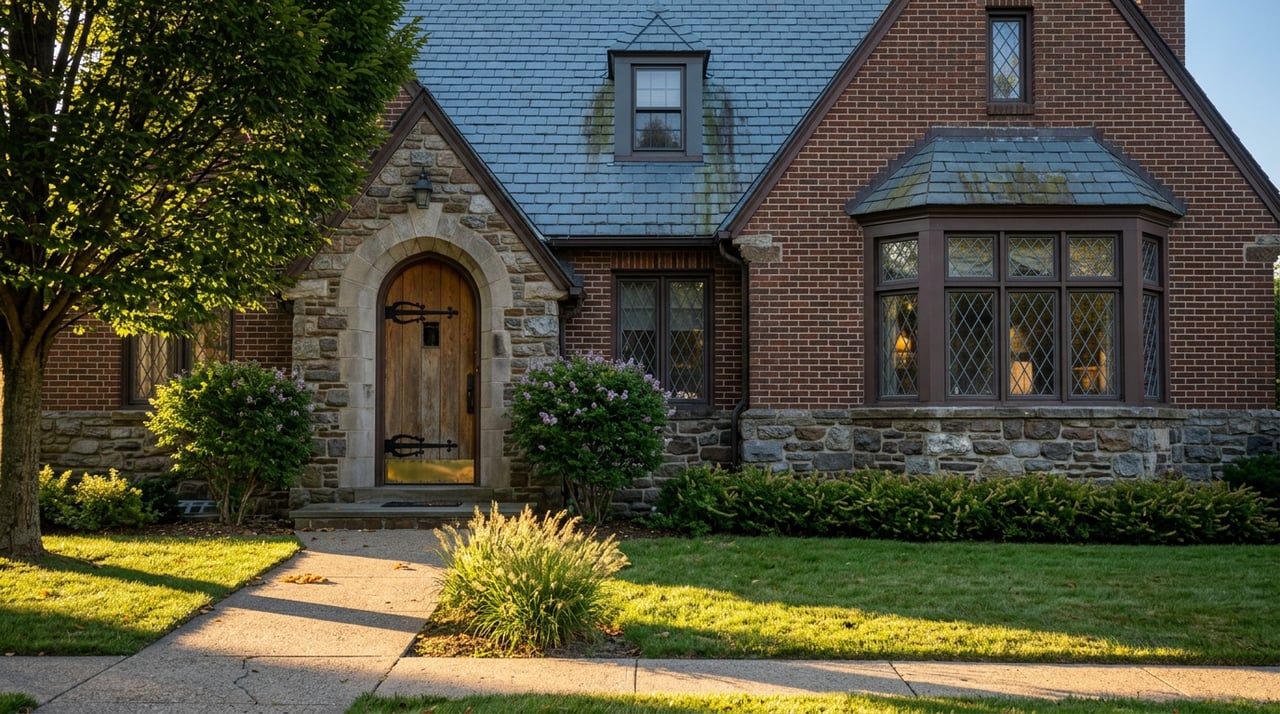
Every listing in Oakland County shows a property tax figure pulled straight from the seller's current bill. Buyers comparing Birmingham to Bloomfield Hills tend to treat that number as a preview of their own future costs. It isn't. Michigan resets the tax math the year after a home changes hands, and the two suburbs don't reset the same way.
Here is the part that surprises people who have already toured both markets: Bloomfield Hills, the pricier of the two on almost every measure, carries a lower effective property tax rate than Birmingham. That is not a typo, and it is not close.
The Number on the Listing Belongs to the Seller
Michigan taxes homes on something called Taxable Value, not market value. Under Proposal A, the constitutional amendment voters passed in 1994, a home's Taxable Value can rise no faster than inflation or 5 percent a year, whichever is lower, for as long as the same owner holds the property. The Michigan State Tax Commission set that inflation multiplier at 1.027 for 2026, meaning a long-time owner's bill can grow at most 2.7 percent this year no matter what has happened to the home's market value.
The cap breaks the moment a deed changes hands. The City of Bloomfield Hills' own Assessing page puts it plainly: the sale of a property triggers an "uncapping effect," resetting the Taxable Value to the State Equalized Value the following tax year. SEV is set by law at half of a property's true cash value, and a recent arm's-length sale price is treated as strong evidence of that value.
Run the Birmingham numbers. Homes there sold for a median $818,000 over the three months ending May 2026, according to Redfin's tracking of MLS data. Half of that is roughly $409,000, which becomes the new SEV a buyer inherits. Multiply that by Birmingham's published total tax rate of 38.1421 mills for principal residences and you land near $15,600 in annual property tax, before the Principal Residence Exemption trims the 18-mill school operating portion for anyone occupying the home as their primary residence.
The part that catches people off guard is timing. The jump doesn't show up at closing. It lands on the tax bill for the year after the sale, which means a buyer's first year can look deceptively close to the seller's old number before the second-year bill arrives at the new baseline.
Why the City's Own FAQ Page Reads Like a Warning Label
Birmingham publishes a public explainer that answers a question its own residents keep asking:
"If the City of Birmingham's local tax rate is 13.1041, why am I paying a total tax rate of 38.1421?"
The city's Treasurer's Office answers it directly: the local municipal rate is genuinely low compared to neighbors like Berkley or Royal Oak, but the total bill stacks in county, school, and special-authority levies on top of it, including Oakland County Parks and Recreation, the regional transportation authority, the zoo authority, and the art institute millage that shows up on the December bill. A low local rate and a high total bill are not a contradiction. They are two different questions.
The Pricier Suburb Taxes Less, on Average
This is where the comparison flips the story most buyers expect. According to Ownwell's tax-rate analysis, Birmingham's median effective property tax rate, meaning actual tax bill divided by market value, runs 1.41 percent, higher than both the Michigan state median of 1.05 percent and the national median of 1.02 percent. Bloomfield Hills sits at 0.77 percent, below the state median, even though its homes cost more.
Two structural reasons explain the gap. Birmingham funds a walkable downtown and a denser mix of municipal services, layering more overlapping local authorities onto every tax bill. Bloomfield Hills, by design, is a low-density residential city with minimal commercial infrastructure and no downtown of its own to fund. The second reason is compositional: Bloomfield Hills has a large share of long-held estates whose owners have ridden the Proposal A cap for years or decades, which pulls the blended effective rate down even as the SEVs underneath keep climbing for anyone who eventually buys in.
That second point matters for a buyer's math. The 0.77 percent figure describes the average owner across the city, not what a new buyer will pay after uncapping. Within Bloomfield Hills itself, Ownwell shows the same pattern in miniature: ZIP 48304 runs a 0.81 percent effective rate while 48302 runs 0.73 percent, a real spread driven by which school district and assessment district a specific parcel falls into.
| Metric | Birmingham | Bloomfield Hills |
|---|---|---|
| Median sale price | $818,000 (3 mo. ending May 2026, Redfin) | $895,000 in ZIP 48301 (July 2026, Movoto) |
| Median price per sq. ft. | $387 to $394 (May to August 2026) | Varies widely by sub-area, no single reliable citywide figure |
| Median effective tax rate | 1.41% | 0.77% |
| Days on market | 20 to 32 (spring to summer 2026) | 19 to 40, depending on source and window |
The Address Inside the Address Matters More in Bloomfield Hills
Birmingham trades in volume. The city logged 111 home sales in May 2026 alone, per Redfin, giving its median price and days-on-market figures real statistical weight. Bloomfield Hills does not have that depth. A local May 2026 market dashboard cited by Bloomfield Hills market analysts showed 64 homes sold that month against only 55 active listings, with inventory down 62 percent year over year. Small sample sizes swing medians hard. A single high-end estate closing can move the whole city's reported price per square foot in a way it simply cannot in Birmingham's deeper pool.
The sub-market spread inside Bloomfield Hills is wide enough to make a single citywide number close to useless for budgeting. Realtor.com data from May 2026 put Bloomfield Village's median listing price at $1.199 million with 34 days on market, ZIP 48301 at $1.1525 million with 23 days on market, and ZIP 48302 at $972,450 with 27 days on market. Three neighborhoods inside one city, three different price tiers and different pacing.
The same logic extends to schools, and it applies in both directions. Birmingham Public Schools' attendance boundary reaches beyond the city limits into Beverly Hills, Bingham Farms, Franklin, and parts of Bloomfield Township, meaning the exact parcel, not the city name on the listing, determines which school operating millage lands on a buyer's bill.
What This Means Before You Write an Offer
- Pull the parcel's current SEV from the local assessor, not the seller's tax bill, and model your post-uncap number against the published millage for that specific address.
- Confirm which school district boundary the parcel sits in. Birmingham and Bloomfield Hills both have boundaries that cross the city line.
- Treat citywide medians for Bloomfield Hills as directional, not precise, given the low monthly transaction count. Ask for a rolling three- to six-month view rather than a single month's snapshot.
- Remember the increase shows up on your second tax bill, not your first. Budget for it a year out, not at closing.
- If the post-uncap SEV looks inflated relative to the actual sale price, both cities hold a March Board of Review. Bloomfield Hills' own Assessing office lists three annual review sessions, the second and third Saturdays in March plus dates in July and December, where an owner can formally challenge the assessment.
Frequently Asked Questions
Does the Principal Residence Exemption work the same way in both cities? Yes. Any owner-occupied primary residence in Michigan, in Birmingham or Bloomfield Hills, qualifies for the PRE, which exempts the property from 18 mills of local school operating tax. It applies uniformly under state law regardless of which city levies it.
When exactly does my tax bill change after I buy? The Taxable Value uncaps to the current State Equalized Value the tax year following your purchase. If you close in 2026, expect your first bill to still resemble the seller's, with the reset landing on the 2027 assessment.
Can I appeal the new assessment if it looks too high? Yes. Both cities hold a March Board of Review where an owner can contest the assessed value. Bloomfield Hills publishes its specific review dates on its city Assessing page, and Birmingham residents can reach the Treasurer's Office directly to start the process.
Comparing Birmingham and Bloomfield Hills on price alone tells you where the entry point is. It doesn't tell you what either city will actually cost you to own once the reset lands. That second number depends on the parcel, the school boundary, and the millage stack behind it, which is exactly the kind of detail worth modeling before an offer goes in rather than after the second tax bill arrives. Maxim Properties runs that math with every Oakland County buyer we work with, alongside in-house financing that keeps the rest of the timeline just as predictable. Schedule a consultation and we'll walk through the specific numbers for the address you're considering.